
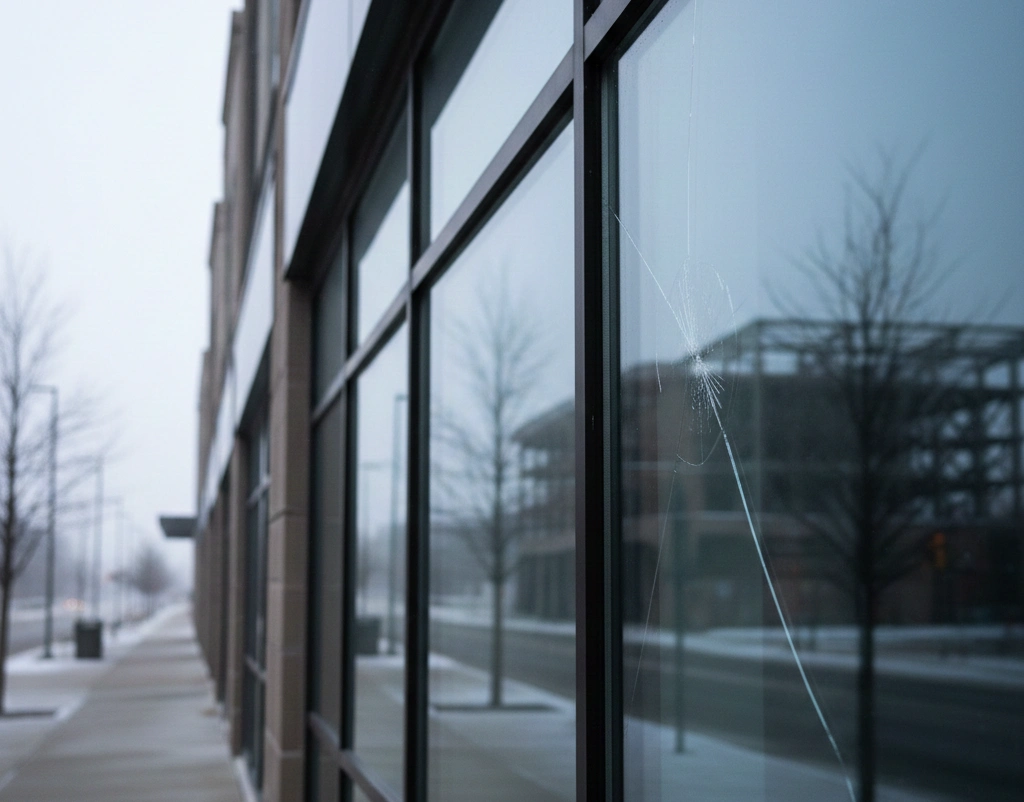
Visualize this. It is a crisp Monday morning in Toronto. You unlock the doors to your building, coffee in hand, ready to tackle the week. You glance at your storefront or office façade and stop dead in your tracks. There is a crack running across your window.
You check the security footage. No vandalism. No errant rocks. No birds hitting the glass. It seems to have happened spontaneously during the night.
It is frustrating, isn’t it? You are left wondering if the glass was defective or if your building is settling. Before you start questioning the structural integrity of your property, take a breath. The culprit is likely not a ghost or a vandal. It is physics. Specifically, it is something called thermal stress.
As seasoned experts in the GTA, we at Prime Windows have seen this scenario play out countless times during our Canadian winters. While it feels mysterious, the science behind it is quite grounded. Let’s walk through why this happens and, more importantly, how you can manage it.
Key Takeaways for Property Managers
- It Is Not Impact: Thermal cracks typically start at the edge of the glass and meander, unlike the “starburst” pattern of an impact break.
- Temperature Differential: The crack is caused by one part of the glass heating up (expanding) while the edges remain cold (contracting).
- Commercial Risk: Large panes, tints, and shadows make commercial properties more susceptible than residential homes.
- Prevention is Possible: Proper glass selection and interior climate management can significantly reduce risk.
What Is Thermal Stress in Glass?
To understand thermal stress glass cracking, you have to look at how glass behaves as a material. Glass expands when it gets hot and contracts when it gets cold. This is usually fine, as the material is designed to handle temperature shifts.
The trouble starts when a single pane of glass experiences two drastically different temperatures at the exact same time.
Imagine the centre of your window pane absorbing heat from the winter sun. It wants to expand. However, the edges of that same glass are buried deep inside a heavy metal frame, which is cold and shaded. Those edges are trying to stay rigid or contract.
This creates a tug-of-war within the glass itself. The hot centre pushes against the cold, locked-in edges. This creates tensile stress. If that stress exceeds the strength of the glass, the material relieves the pressure, the only way it knows how: by snapping.
Why Cold Weather Triggers Thermal Stress Cracks
You might ask, “If heat causes the expansion, why does this happen in winter?”
That is a fair question. It comes down to the temperature difference, or the “delta.”
In the summer, the outside air is warm, and the inside is cool. The difference is manageable. But in a Canadian winter, the contrast is extreme. Your interior might be a comfortable 21°C, while the exterior is a biting -15°C or lower.
Commercial windows cracking in cold weather often happens on those bright, freezing mornings. The sun hits the glass, rapidly heating the centre, while the edges remain frozen by the frame and the ambient outdoor air.
Furthermore, snow buildup on the sill can act as a partial shade or even a reflector, intensifying the heat on one part of the glass while keeping the bottom edge icy. This uneven heating is the perfect recipe for thermal stress cracks in glass.
Why Commercial Windows Are More Susceptible
Residential homes certainly experience thermal cracks, but commercial properties are in a league of their own when it comes to risk factors. Why is that?
- Size Matters: Commercial buildings use massive glazing units. The larger the pane, the more surface area there is to absorb heat, and the greater the expansion potential in the centre.
- Coatings and Tints: Commercial aesthetics often rely on tinted or reflective glass. While these look professional and reduce glare, they also absorb significantly more solar radiation than clear glass. Low-E glass coatings are fantastic for energy efficiency, but they also affect how the glass manages heat, which can occasionally cause stress if not calculated correctly.
- Complex Systems: Curtain wall systems and storefront glazing systems involve heavy framing. These frames act as massive heat sinks, keeping the glass edges much colder than the centre of the pane.
Common Causes of Thermal Stress Cracks
It is rarely just “it got cold.” Usually, there is a contributing factor that pushed the glass over the edge.
Edge Damage and Micro-Chips
This is the silent killer. During manufacturing or installation, the edge of the glass, the part hidden inside the frame, might suffer a tiny chip or “clam shell” damage. Under normal conditions, this is harmless. But under thermal stress, that microscopic chip acts like a zipper. It provides a weak point where the crack can easily initiate.
Improper Glazing Clearances
Glass needs room to breathe. If the glass is installed too tightly against the metal frame without proper blocks or gaskets, it has nowhere to expand.
Partial Shading
This is one of the most overlooked causes. If a large overhang, a mullion, or even a sign casts a shadow over half the window while the other half bakes in the sun, the temperature difference across the face of the glass skyrockets.
Failing Insulated Glass Units
When an insulated glass unit (IGU) failure occurs (meaning the seal breaks), moisture can get inside. This alters the unit’s thermal properties and can create hot spots that lead to breakage.
Also Read: Why You Should Never Ignore a Cracked Window or Door – Risks & Solutions
Thermal Stress vs Impact Damage (How to Tell the Difference)
Diagnosing the break is the first step toward commercial glass replacement. You do not want to pay for a thermal break if it was actually vandalism (which might be an insurance matter), nor do you want to blame a vandal if your system configuration is at fault.
Impact Damage:
- Usually has a distinct “point of impact.”
- Cracks radiate outward in a starburst or spiderweb pattern.
- There might be crushed glass at the centre.
Thermal Stress:
- The crack almost always originates at the edge of the glass, hidden by the frame.
- It starts perpendicular (90 degrees) to the edge, then meanders across the pane.
- It looks like a lazy, wandering line rather than a violent shatter.
If you see a wandering line starting from the frame, you are likely looking at thermal stress.
Does Tempered or Laminated Glass Prevent Thermal Stress?
Not all glass is created equal when it comes to battling the cold.
Tempered Glass:
This is your heavyweight champion. Tempered glass is heat-treated to be approximately four times stronger than standard annealed glass. It is incredibly resistant to tempered glass thermal stress. While not invincible, it is very rare for tempered glass to break solely due to temperature changes in a typical building environment.
Heat-Strengthened Glass:
This sits between standard and tempered. It acts similarly to annealed glass but has been treated to withstand higher thermal loads. It is a popular choice for commercial spandrel panels.
Laminated Glass:
Laminated glass’s winter performance is generally good, but it behaves differently. Because it consists of two plies of glass bonded with an interlayer, it holds together if it cracks. However, the individual plies can still suffer thermal shock. In fact, different expansion rates between the glass and the interlayer can sometimes add complexity to the stress levels.
Ontario Building Code & Commercial Glass
Navigating the Ontario Building Code is part of our daily life at Prime Windows. The code is heavily focused on safety, specifically, ensuring that if glass breaks, it does not injure pedestrians or occupants.
This is why safety glazing (tempered or laminated) is required in doors, sidelites, and areas susceptible to human impact. However, the code sets minimum standards for safety, not necessarily for thermal durability. A window can be perfectly code-compliant and still suffer a thermal crack if the wrong glass type was specified for a particularly shadowy corner of your building. Compliance does not essentially guarantee immunity from physics.
Who Is Responsible When Commercial Glass Cracks?
This is the uncomfortable question. When a window breaks six months after installation, who pays?
If it is commercial glass replacement in winter scenarios, the lines can be blurry.
- The Manufacturer: If there was a defect in the glass (like a nickel sulphide inclusion in tempered glass), it might be a warranty issue. However, most standard glass warranties specifically exclude thermal stress breakage unless heat-strengthened glass was used.
- The Installer: If the glass was chipped during installation or the glazing blocks were placed incorrectly, the responsibility may lie here.
- The Specifier/Architect: If annealed glass was specified for a south-facing window with heavy partial shading, the error was in the design phase.
For property managers, having detailed storefront glass repair records and original shop drawings can be vital in determining liability.
Also Read: Can I Repair My Cracked Glass?
How to Prevent Thermal Stress Cracking
You cannot control the Toronto weather, but you can control how your building handles it.
- Proper Specification: The best defence is offence. For areas with high thermal risk (south-facing, partially shaded), use heat-strengthened or tempered glass.
- Interior Management: Do not place heavy blinds, signs, or furniture directly against the glass. This traps heat between the object and the window, causing the glass temperature to spike while the exterior stays freezing.
- Air Circulation: Ensure warm air from your HVAC system washes over the glass evenly to prevent cold pockets.
- Regular Inspections: Catching an insulated glass unit (IGU with a failing seal early can prevent a sudden crack later.
What to Do If a Commercial Window Cracks in Winter
So, you have identified a thermal crack. Now what?
First, ensure safety. If the glass is loose, secure the area immediately to protect tenants and the public. Do not attempt to push on the glass.
Next, you need a professional assessment. This is not the time for a handyman fix. You need emergency glass repair services that understand commercial systems. A professional can apply a specialized film to hold the glass together temporarily or board it up if necessary while a new unit is fabricated.
When you arrange for the replacement, ask about upgrading. If this window cracked due to thermal stress, replacing it with the exact same glass type might just lead to a repeat performance next winter. We often recommend upgrading to tempered or heat-strengthened glass for that specific opening to prevent recurrence.
FAQs
Can cold weather alone crack glass?
Not usually. It is the difference in temperature (hot centre, cold edge) or a rapid change in temperature that causes the break, rather than the cold itself.
Is thermal stress covered by insurance?
It depends on your policy. Many commercial policies cover “accidental breakage,” but some exclude damage caused by temperature extremes or inherent vice. Check with your broker.
Can tempered glass crack from cold?
It is extremely rare. Tempered glass can withstand temperature differentials of over 200°C. If it breaks, it is usually due to impact or a rare manufacturing impurity.
Why do cracks start at the edge?
The edge is the weakest part of the glass and is buried in the cold frame. This is where the tensile stress (pulling apart) is highest.
Will replacing one pane solve the problem?
If the crack was caused by a random edge chip, yes. If it was caused by the window’s location and shading, you should upgrade to stronger glass to avoid it happening again.
Does Low-E glass increase thermal stress?
It can. Because Low-E coatings reflect heat back into the room or absorb it, the glass itself can get hotter than clear glass, increasing the stress on the cold edges.
Winter-Proofing Your Business Glazing: A Final Thought
Waking up to a cracked window is never part of the business plan, but understanding why it happens takes the fear out of the equation. Whether it is the biting wind, the angle of the sun, or a shadow from the building next door, thermal stress is a manageable challenge.
Remember, a crack is not just a cosmetic issue; it is a sign that your building envelope is fighting a battle against the elements. By choosing the right materials, keeping clear records, and responding quickly with professional help, you can keep your property secure and warm.
If you are staring at a mystery crack or just want to assess the health of your building’s glazing before the deep freeze sets in, we are here to help.
Ready to secure your property? Contact Prime Windows today for a comprehensive commercial glass assessment.