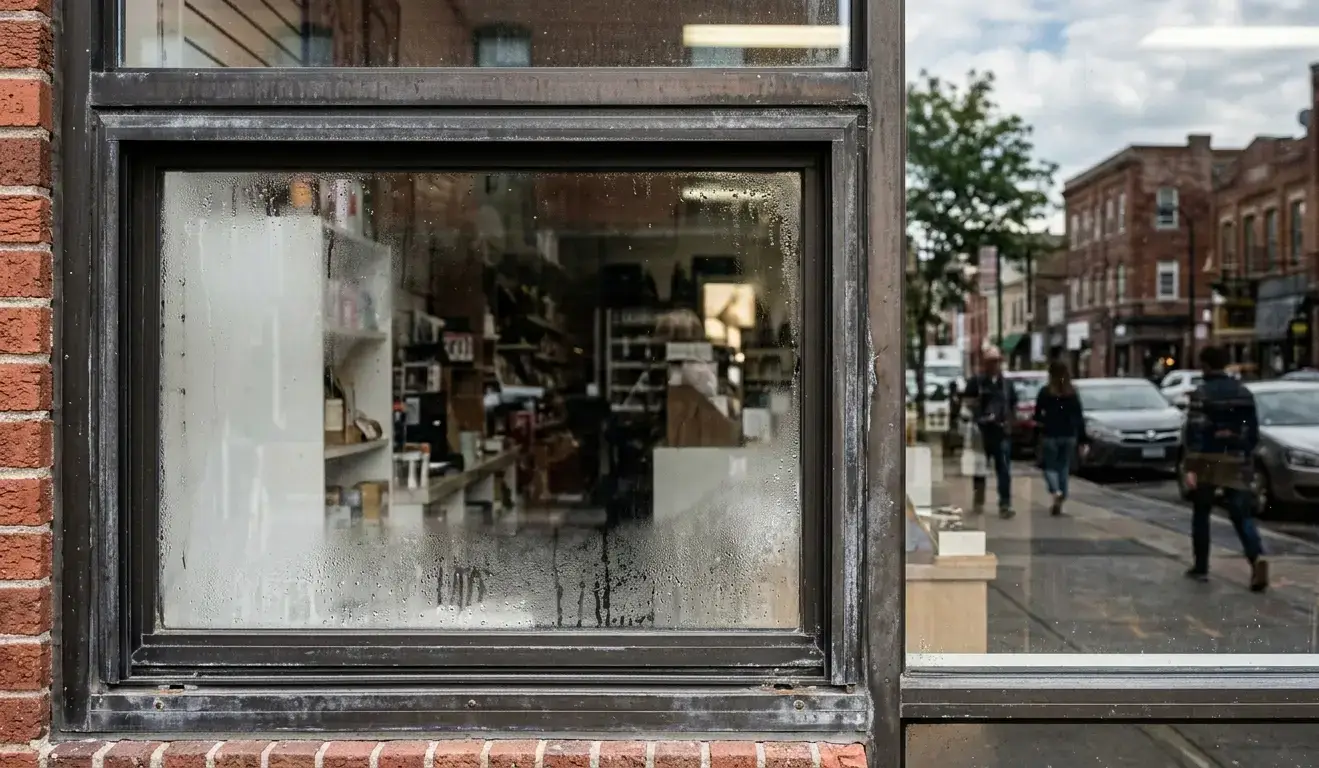
Have you ever walked up to a shop on a crisp Toronto morning, only to find the front windows completely clouded over? It looks a bit like a sauna inside, right? As a business owner or property manager, dealing with foggy storefront glass is incredibly frustrating. Your storefront is the face of your business. It is your silent salesperson. When it looks murky, unkempt, or neglected, it quietly damages your curb appeal and erodes customer trust. Nobody wants to peer through a milky haze to see what you are selling.
You might be thinking about the worst-case scenario right now. Are you looking at a massive renovation bill? Does the whole frame need to be ripped out? Take a deep breath. We get it, running a commercial space comes with enough headaches. The good news is that not all foggy glass requires a total teardown. Sometimes the fix is simpler than you expect, though other times, it is indeed a symptom of structural failure.
In this guide, the experts at Prime Glass Windows will walk you through exactly how to diagnose your window woes. We will help you figure out the root cause and determine the most cost-effective solution for your commercial property.
Key Takeaways
- Location is Everything: Knowing whether the fog is on the inside, outside, or trapped between the panes is the crucial first step in diagnosing the issue.
- Seal Failure Explained: Moisture trapped between panes is a glaring red flag for storefront seal failure, meaning the insulating properties of your window are compromised.
- Options Exist: You do not always need to replace the entire system. Often, you can replace the IGU without replacing frame components, saving you significant time and money.
- Safety First: Commercial spaces have strict building codes. Upgrading to proper safety glass protects your customers and shields you from liability.
First Step – Where Is the Fog Actually Appearing?
Before you start budgeting for a massive renovation, you need to play detective for a minute. Where exactly is the moisture sitting? Grabbing a clean cloth and doing a simple “wipe test” will tell you almost everything you need to know.
- Fog on the inside surface: If you wipe the glass from inside your store and the fog disappears, you are dealing with indoor humidity. This is very common in cafes, restaurants, or spaces with poor ventilation. A quick fix to your HVAC system or running a dehumidifier will usually nip this in the bud.
- Fog on the outside surface: If the condensation is on the exterior, it is just Mother Nature doing her thing. Morning dew and rapid temperature changes cause this temporary condensation. It is completely harmless and usually burns off as the sun comes up.
- Fog between the panes: If you wipe both the inside and the outside, but the milky haze is still staring back at you, you have a problem. This is condensation between glass panes that commercial property owners dread. It is the undeniable hallmark of a failed window seal.
What Seal Failure Means in Storefront Glass
To understand why your window is suddenly acting like a terrarium, we need to talk about how modern windows are built. Most commercial properties use an Insulated Glass Unit, commonly known as an IGU. Picture a perfectly sealed sandwich. The bread is the two panes of glass, and the filling is a layer of inert gas, usually argon, trapped inside.
Around the perimeter of this sandwich is a heavy-duty seal holding it all together. Tucked inside the spacer bar between the glass is a desiccant. Think of the desiccant like those little silica gel packets you find in a new pair of shoes; its job is to absorb any stray moisture.
When you have an IGU seal failure, commercial grade or otherwise, it means that the perimeter seal has broken. The insulating argon gas leaks out, and regular, moisture-laden air sneaks in. Eventually, the desiccant gets completely saturated and can no longer absorb the vapour. The result? Permanent, trapped moisture that turns into an ugly, cloudy film on your foggy double-pane storefront window. It is like a high-end thermos that has lost its vacuum seal. It just will not do its job anymore.
Also Read: How to Deal with Condensation Between Window Panes
Common Causes of Storefront Seal Failure
Why do these seals give up the ghost in the first place? It rarely happens overnight. Storefront glass fogging causes are usually a mix of environmental stress and time.
- Thermal Expansion and Contraction: Toronto weather is notoriously dramatic. We go from deep freezes to blazing heat. This constant expanding and contracting puts immense physical stress on window seals, eventually causing microscopic tears.
- Age and UV Exposure: Nothing lasts forever. Constant exposure to the sun’s harsh ultraviolet rays will eventually degrade even the toughest commercial sealants.
- Blocked Weep Holes: Your window frames have tiny drainage holes designed to let water escape. If these get clogged with dirt, dead leaves, or debris, your glass ends up sitting in a puddle of water. This constant exposure rapidly rots the seal.
- Building Movement and Vibration: Commercial buildings settle over time. Add the rumble of heavy city traffic or a nearby subway line, and that constant micro-vibration can weaken the structural integrity of the glass seals.
- Improper Installation: If a previous repair was poorly done or if wet glazing was misapplied, the seals are doomed to fail prematurely.
Do You Need a Full Glass Replacement?
This is the golden question. When balancing the budget and business operations, you need to know your options. Let us break down when to repair, when to swap the unit, and when to start fresh.
When repair or maintenance is enough
If the glass itself is clear but you notice drafts or minor water pooling, you might be in luck. If the fog is strictly humidity-related and your frames are rock solid, a simple tune-up is often enough. Clearing out blocked drainage holes, upgrading your perimeter sealants, and adjusting your indoor ventilation can work wonders. In this scenario, assessing storefront glass repair vs replacement tilts heavily toward simple maintenance.
When IGU-only replacement makes sense
This is the sweet spot for many businesses. If you have confirmed a seal failure but your aluminum framing is straight, sturdy, and free of corrosion, you are a prime candidate for replacing the insulated glass unit. The professionals at Prime Glass Windows can carefully remove the failed glass sandwich and install a brand-new IGU right into your existing frame. It is a brilliant way to restore your storefront’s pristine look and energy efficiency without the hefty price tag of a full rebuild.
When full glass replacement is required
Sometimes, throwing a Band-Aid on a broken leg just will not cut it. You will need a commercial storefront glass replacement if:
- The glass has become permanently etched or stained by mineral deposits from long-term trapped moisture.
- There are deep cracks, large chips, or severe edge damage compromising the structural integrity.
- The aluminum frames are out of square, badly corroded, or failing to support the weight of the glass.
- You have experienced repeated IGU failures in the same frame.
- You are legally required to perform safety upgrades to meet modern building codes.
Safety & Compliance Considerations for Storefront Glass
Running a business means taking liability seriously. When we talk about commercial glazing, we are not just talking about aesthetics; we are talking about human safety. Modern building codes require specific safety glazing in high-traffic commercial environments.
If someone accidentally trips and falls against your storefront, standard annealed glass will shatter into massive, lethal shards. That is a lawsuit waiting to happen. To stay compliant and protect your customers, storefronts require tempered glass (which shatters into small, blunt pebbles) or laminated safety glass (which holds together like a car windshield when broken). If your current setup is hopelessly outdated, bringing everything up to code with proper safety glass is a non-negotiable part of the replacement process.
The Cost of Waiting (Beyond Appearance)
Procrastination is expensive. Leaving a failed window untouched does more than just hurt your brand’s image.
First, your energy efficiency plummets. Without that insulating gas, your HVAC system has to work overtime to keep your store warm in the winter and cool in the summer. Those utility bills will creep up steadily. Secondly, trapped moisture can seep into the framing, causing hidden corrosion and structural damage. What could have been a simple IGU swap today might turn into a massive, mandatory commercial glazing replacement project next year. Nip it in the bud before the damage spreads.
What the Replacement Process Looks Like for Businesses
We know the idea of replacing glass sounds chaotic. You are picturing shattered glass everywhere and days of lost revenue. But professional commercial storefront services are designed to be entirely frictionless.
Here is what to expect: Our team arrives for a quick, non-intrusive on-site assessment to take precise measurements. We then order your custom glass to spec. Once it arrives, we schedule the installation during your off-peak hours to minimize downtime. We set up clear safety barriers to protect pedestrians and your patrons. The old glass is removed, the frame is prepped, the new unit is locked in, and a final quality check is performed. You walk in the next morning to a flawless, sparkling storefront.
Repair vs Replace – A Simple Decision Checklist
Still on the fence? Use this quick cheat sheet to evaluate your situation:
| Factor | Consider Repair / Maintenance | Consider IGU Swap | Consider Full Replacement |
| Location of Fog | Inside or outside surface | Between the panes | Between panes + etched glass |
| Frame Condition | Excellent | Good, structurally sound | Warped, corroded, out of square |
| Glass Condition | Intact, no scratches | Foggy, but physically intact | Cracked, deeply scratched, chipped |
| Safety Compliance | Already up to code | Already up to code | Needs safety glazing upgrade |
| Urgency | Low | Moderate (Aesthetic/Energy) | High (Safety/Liability risk) |
Also Read: Top Signs It’s Time to Replace Your Windows and Doors
Frequently Asked Questions
Can foggy storefront glass be repaired?
You cannot “unfog” a failed IGU by wiping it or drilling holes in it. The only true repair for moisture trapped between the panes is to replace the affected glass unit.
How can I tell if it’s a seal failure?
Do the wipe test. If you clean both the inside and outside of the glass, but the cloudiness remains trapped in the middle, your seal has failed.
Is IGU replacement cheaper than full replacement?
Absolutely. If your aluminum frames are in good condition, swapping out only the glass unit saves considerable material costs and drastically reduces labour time.
How long does storefront glass replacement take?
The installation itself is remarkably fast. For a standard IGU swap, our technicians can usually complete the job in a few hours.
Will the new glass match my existing storefront?
Yes. Professional glaziers will carefully match the tint, thickness, and reflective properties of your existing glass so the new unit blends in seamlessly with the rest of your building.
Clearing the Fog: Your Blueprint for a Crystal-Clear Storefront
A foggy window is not a death sentence for your commercial space, but it is a clear call to action. To quickly recap: condensation trapped between your panes almost always points to seal failure. Fortunately, if your frames are still fighting fit, you can often save money by opting for a targeted IGU replacement rather than tearing out the whole system.
The key is to act before structural damage worsens and your energy bills skyrocket. A professional assessment will take the guesswork out of the equation and ensure you are making a smart, compliant investment in your property.
Are you dealing with an unexpected shatter or an urgent security risk? We also handle emergency glass repair to secure your premises immediately.